Colchester Lumber Industry
The Township was heavily timbered with pine and hemlock. Early pioneers opened water run sawmills to provide cut lumber for building their homes and farms. The first water run sawmill in Colchester was opened by William Rose in 1790. Sawmills expanded across Delaware County, increasing from 54 in 1820 to over 240 by 1840. A quarter of men were employed in the lumber industry by 1870.
Local hemlock timbers were often brought to mills like these in trade for the custom sawing fees. These boards were used for building construction, farm repairs and furniture. An average price for custom sawing fees in the 1890’s was $1.50 per thousand feet of lumber.
Shingles were sawn with a consistent thickness from end to end. Custom hemlock shingles sold for about $3.00 per thousand shingles and were packed in bundles of 250 shingles. In this time period shingles were usually sawn in 16, 18, 20 and 24 inch sizes. The most common shingle was 16 inches, laid with a 4 ½ inch exposure, this would cover 125 square feet or a “carpenter’s square”, a unit of measure of a roof area.

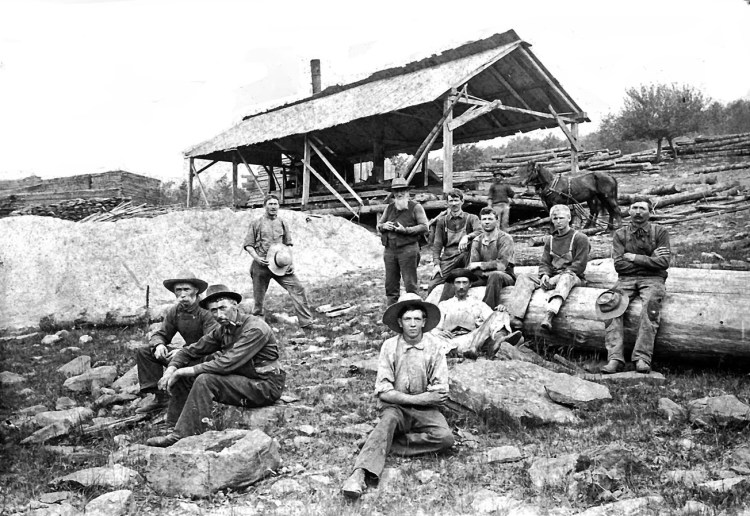
Lumber–Colchester Cash Crop
It was the custom in the early days of Delaware County for farmers to keep only a few of their summer cows over the winter months. Farm families might begin lumbering operations soon after haying and then spend the winter in the woods clearing the land and its valuable crop—lumber; and at the same time making the land more available for farm operations. The whole winter’s work of cutting skidding and hauling logs to the river was focused on the final operation of rating the logs and running to market.
Colchester Sawmills
Lumber was a major industry in Colchester and Delaware County. In 1840 there were 220 sawmills in Delaware County and by 1870 more than one quarter of men were employed in the lumber industry. The 1869 Beers Atlas listed 37 sawmills in Colchester, 10 of these were located on Downs Brook. The construction of the D& E Railroad from 1903-6 led to lucrative contracts for local sawmills for lumber for ties and trestles.
One of the largest sawmills was located on the “Brooklyn side” of Downsville. The Downsville sawmill had a contract to cut more than a half a million board feet of lumber for the construction of the D & N’s Muir Trestle on the Andes branch. The trestle was built across the Tremperskill River on the farm of H. L. Muir and was 450’ long, 45’ high, and used 190,000 feet of hemlock timber in its construction. This trestle was used in a dramatic scene in the 1920 film, “The Single Track” a silent movie starring Corinne Griffith.
After the closing of the B & B Creamery on Depot St. in the mid 1940’s, Channing Cable purchased the buildings and operated his sawmill on that property until his death. The family sold the business to the Como Lumber Company. The Como Lumber Company operated a modern all electric mill in the former B&B Creamery buildings until the mill was destroyed by a fire on January 29, 1970.
 Colchester Historical Society