
Early Settlers
Horton was named for David Horton who settle at the foot of Horton Brook and was one of the first raftsmen in that area. He built a mill on Horton Brook and rafted large amounts of sawed timber down the Delaware River. He was the father of seven sons, John, Samuel, Boliver, Orrin, Andrew Jackson, Herschal and Perry who all joined their father rafting on the Beaverkill. Herschal Horton became the most influential in the area becoming a Justice of the Peace, farmer, lumberman, as well as, a famed rafter.
Other lumbermen in the Horton area were Alred and Levi Baxter,Thomas Edwards, Alexander and Charles S. Elwood, Archibald Campbell,George, Jack, Samuel, Nathan, Harrison and Jared Fuller, Henry and Hank Johnston, Benjamin Gray and Frank Walker.
Herschal D Horton became very influential in the Horton area and was the justice of the peace, a farmer as well as famed lumberman and rafter.
The large extended Fuller family populated the Horton area; at one time fourteen Fuller families lived between Horton and Corbett. The road from Horton to Corbett is still referred to as Fuller Hill Road.
Other farm families in the Horton area include Justin Merrill, Thomas Edwards, John Stadel,Horace Utter, Frank and George Baker, John Elfrey as well as several small farms owned by the Hortons, Tompkins and Brushes families.
Wood Products and Acid Factories
Samuel W. Cable bought 2,000 acres from Horace Utter on Russell Brook in 1880 and started a wood products business. Hemlock and hardwood were used to make shingles and wooden shoe pegs that were used to hold the soles on shoes. Cable employed one hundred people in his factory. His complex included a blacksmith shop, a horse barn, a boarding house and several other houses for his workers. A series of five dams were built by Cable, one of which was one hundred feet wide near the Russell Brook Falls.


Cable also owned five sawmills, one in Walton, Rock Rift, Liberty, Russell Brook and one at the head of Cable Lake. When the O & W double tracked between 1902 and 1904 Cable supplied two million feet of hemlock which was used for their bridges and tunnels.
Once the timber was depleted on Cable’s land the wood products business closed. Cable then tried to take advantage of the new sport of fly fishing in the Catskills by starting a fee based fishing business. He built a series of three artificial fishing ponds stocked with trout and the Roscoe Rockland Review reported that they were known, “as the best stocked trout waters in this section,” of the Catskills. The venture failed to be a paying investment and the Cable property was sold to the Leighton Co. of Cooks Falls in 1905 for $12,000. The following year, on June 14, 1906, Samuel W. Cable drown in the Delaware River in Walton, NY.
June 14, 1906
Roscoe Rockland Review
“Word was received here Saturday of the death of Sam Cable of Russell Brook, by drowning in the Delaware at Walton, where he was stopping with his brother, Edward.
“Mr. Cable was in an asylum at Binghamton last winter and as his condition improved his brother Edward, who owns a farm near Walton, removed him from the asylum to his place about a week ago. Saturday afternoon the two brothers were out in the field near the river working and Mr. Cable appeared to be quite rational. His brother, whose health is poor, became tired and went into the house to rest, leaving him alone. Returning to the field later, he missed his brother and upon investigating, found his hat on the bank
of the river and later discovered the body in the water.
“Mr. Cable has lived on Russell Brook for about 25 or 30 years where he owned a large farm of over a thousand acres. At one time he was a very prominent lumber man on Russell Brook, running a saw mill
and a peg factory, employing a number of hands in the latter. He failed in business a number of years ago and since that time his main hobby seemed to be the building of artificial fish ponds of which he now has three on the place, well known to be the best stocked trout waters in this section. This last venture failed to prove a paying investment and last year his brother sold the farm of about 1,200 acres to the Arthur Leighton Co of Cooks Falls for $12,000.
“Mr. Cable was about 60 years of age and is survived by his wife, one daughter, Mattie; three sons, Chandler, Bert and Warner; two brothers, John of Harvard and Edward of Walton with whom he was staying.

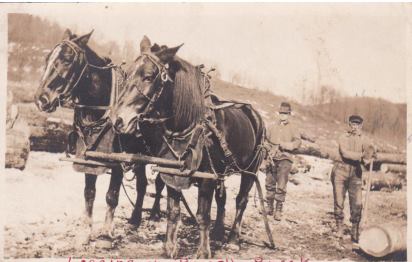
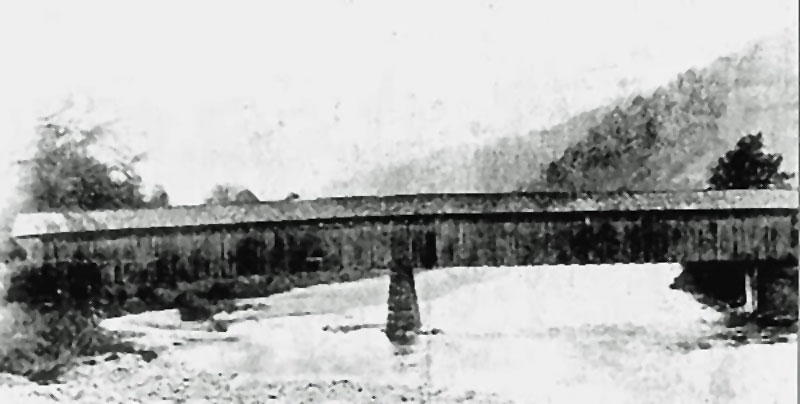
In 1898 George I. Treyz built a retorts acid factory on Russell Brook near Cooks Falls. The plant operated six days a week, consuming 32 cords of four foot wood per day from 1898 until 1924.The plant employed over one hundred men in the factory, lumbermen cutting four foot cord wood and teamsters to haul the wood to the factory. In 1911 Treyz contracted to install a John Roebling Bridge, this railway bridge that went over the Beaverkill River and connected his factories with the O&W railway in Cooks Falls. The bridge and narrow gauge railway travelled five miles up Russell Brook to his Horton factory. This side rail allow Treyz to ship his timber to his sawmill and sidewalk bluestone directly to the O&W station for shipments to New York City. In 1924 the factory was converted to the new style oven plant and increased its capacity to 36 cords per day. This new factory burned in 1925 and was rapidly rebuilt. George Treyz died shortly after the factory was rebuilt and the operation was taken over by his son Victor.

Victor modernized the factory and installed an alcohol refining column which produced pure methanol. This product was sold as antifreeze under the name of Treyzone.
Treyz operations changes also included the use of bulldozers to get wood off the steep hills and down to the roads where his large fleet of trucks could be directly loaded and taken to the acid factory. Treyz also added a formaldehyde plant and in the late 1940’s he expanded to include a plant to make acetic acid directly from the wood liquor. The Treyz’s company was the last acid factory in operation in New York State. Victor Treyz died in 1949 and left his holding to his sisters.
Laura Treyz took over the business and dismantled the still house and the plant converted over to the production of charcoal. Charcoal was once the least profitable product of the company but there was new demand for charcoal in the production of steel, basic chemicals, rayon, rubber, glass, copper, brass and bronze. The plant was sold to the Susquehanna Chemical company in 1951 which reported that 50% of the charcoal production was devoted to the manufacture of carbon disulphide used in making rayon. The Susquehanna Chemical Company continued the charcoal plant until it was torn down to make way for the Route 17 Quickway in 1967.


The property for the one-room Horton School was given to the community by George I Treyz in 1916 with the provision that if the school was outgrown the building would be used as a community church. Later a two-room school was built up the hill from the original building on the Rex Stadel property.
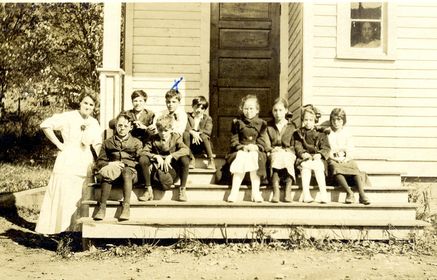
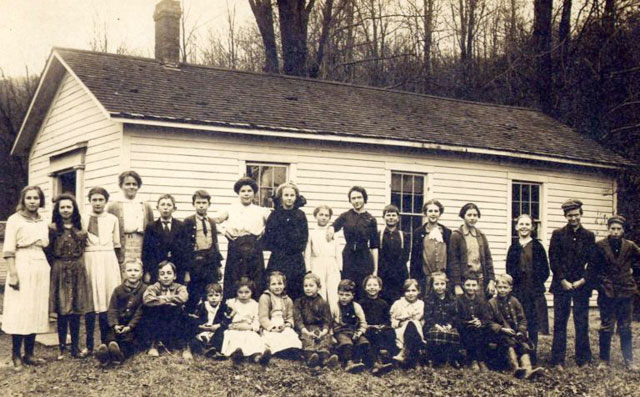

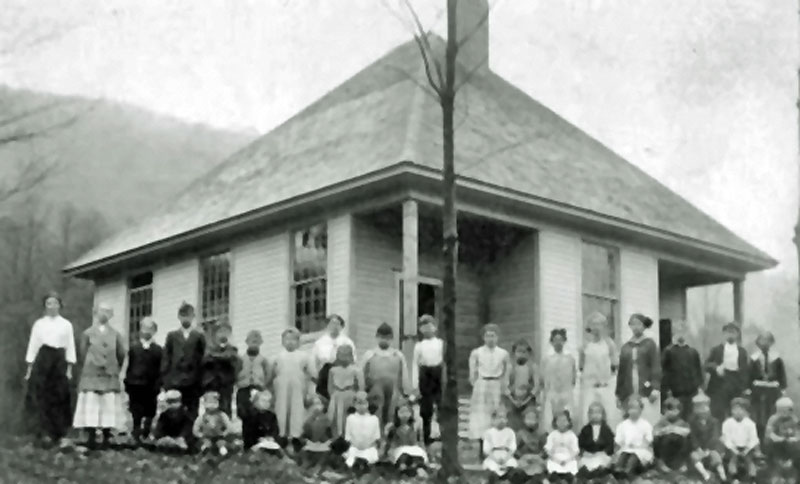
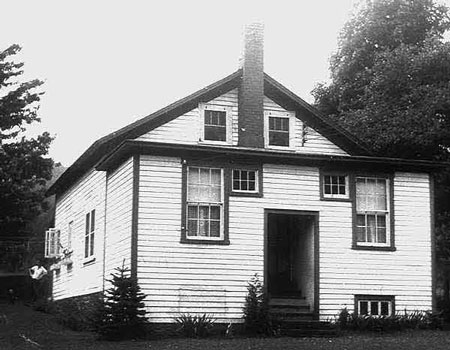
The Russell Brook School was located on the Samuel W. Cable property across from the road that leads to Trout Pond and the Butternut Grove school was located where Russell Brook runs into the Beaverkill., both were part of District No. 12.
Churches
Horton Chapel
The Horton Chapel or Community Church began in the former one-room schoolhouse in 1915. The church started as a non-denominational congregation but later join the Methodists and was linked to the Cooks Falls and Beaverkill Circuit. A dwindling congregation necessitated the sharing of a pastor with the Rockland and Cooks Falls Methodist Churches in 1943. The Horton Church Trustees rejected an offer to merge with the Cooks Falls Methodist Church in 1960 and choose to remain with a shared pastor. In July of 1965 the trustees learned that the Route 17 Quickway would take their building. The State Department of Public Works appraised the property and bid $6,000 ($5,950, if the church wised to retain the altar, pulpit and lectern). On August 25, 1967 the members voted to accept the offer. The monies received were given to the New York Conference of the Methodist Church, along with the altar and furnishings. The building was razed during the Quickway construction.
Horton Brook Free Methodist
Gerald Babcock and David Horton organized a young people’s Christian group in the kitchen of the Babcock family home. They organized a tent revival meeting that was held on the Rex Stadel land near the Horton Cemetery. Evangelist Rev. R. A Kelly from Confluence, Pennsylvania, lead the meetings from July 25 to August 3, 1950. A second tent meeting was also held in Butternut Grove.
Rev. Lewis Payne, organized the Free Methodist society with fourteen original members and seven probationers. A one dollar subscription church building fund was created and the land for the church building was given by Gerald Babcock’s grandmother. The first ordained minister was Rev. Arthur Boland. The John McGraw farmhouse was remodeled for the parsonage.





 Colchester Historical Society