
Colchester One-Room Schoolhouses
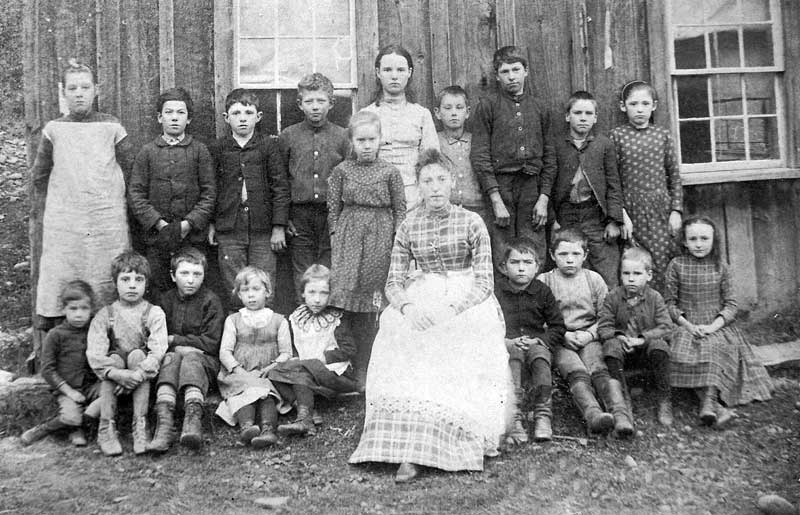
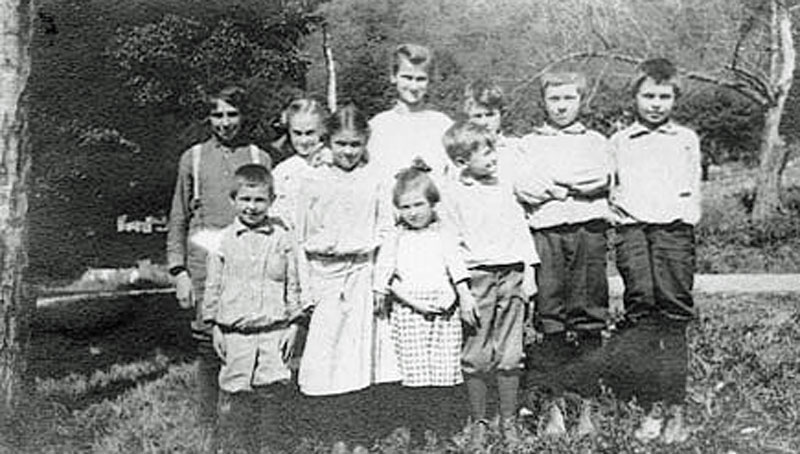
In the late 1800’s Colchester had 30 one-room schoolhouses, more than any other town in Delaware County. Each school district size was between three to five square miles, as most students walked to school. The school year was generally split between two terms. Female teachers taught in the summer term when younger children went to school. Male teachers were preferred for the winter term because older boys attended in the winter and it was thought that male teachers would keep better control of the students. Male teachers were paid more for the winter term, but were expected to split and stack firewood as well as maintain the woodstove fires in the schoolhouse.
At the annual Town meeting on March 13, 1813 it was, “Resolved that the sum of seventy dollars be raised for the support of schools.”
“Better education was both a goal and a tool in the comprehensive modernizing projects of the nineteenth century, and in many rural communities the school became a trigger for the development of democratic and social institutions. The schoolhouses were in most communities the first public building to be erected, and became an arena for social, political and religious meetings. The school boards were often the first democratic institutions established in the local communities, and played a vital role in the development of democratic society in the late nineteenth century. Last but not least the one-room schoolhouse held notable significance as an institution for education, and represented a shift towards better education and schooling.” Jonathan Zimmermann, Small Wonder: The Little Red Schoolhouse in History and Memory
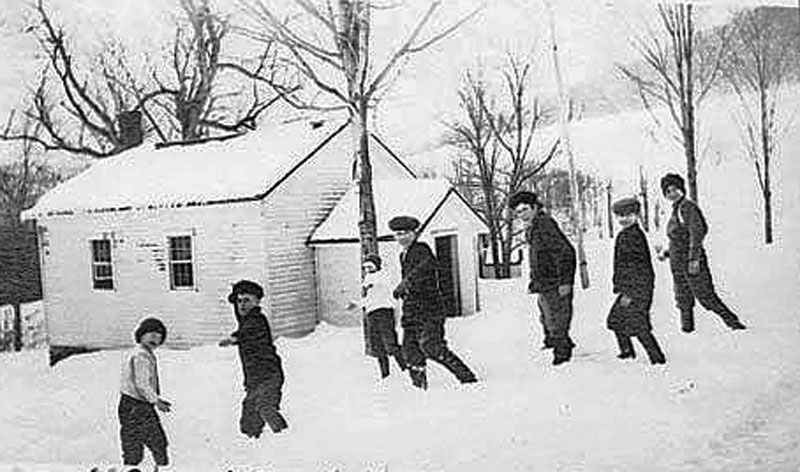
In the US, the schoolhouses developed from simple log buildings built by the first pioneers to the typical balloon-framed, wooden-sided, white-painted one-room schoolhouses like the ones built in the Town of Colchester. Although a number of architect sketches of schoolhouses were made in the second half of the 19th century, most farmers built their schoolhouses according to local tradition, or copied from neighboring schoolhouses. Most were small rectangular buildings, seldom larger than two or three bays wide and two or three bays deep, with windows on at least three sides. Many were approximately 16 x20, 18 x 20 or 20 x 24 feet in size, with clapboard siding and broad gabled roofs. Most had entrances on the end, with a space allocated for storing coats and lunches, for library books and a single open teaching space with blackboards and all heated by single wood stove. New York State Commissioner of Education had to approve plans for school buildings costing more than $500 and building plans were required to include details about ventilation, heating and lighting. School buildings were required to provide 30 cubic feet of air a minute for each pupil, fifteen feet of floor space, written plans for egress in case of fire, windows
on the left side of the building and some window light from the rear, windows needed to be extended as near the ceiling as possible, a ratio of 1 to 5 of window surface to floor space, blackboards placed at 26 inches for primary grades, 30 inches for grammar grades and 36 inches in intermediate grades. A special cloak room needed to be properly lighted and heated. It was also suggested that rooms should be painted a light greenish gray with curtains matching the wall color. Privies were not required until around 1900, but the Commissioner strongly suggested that trustees provide those facilities for the students and teachers. The Commissioner’s plans called for separate outbuildings, but covering these two separate sections could be placed under one roof. Separate access and approaches were encouraged, with a substantial 7 foot fence separating the two privies. The School Commissioner could order the trustees to spend up to $50 to construct these outbuildings. Trustees could use some variety in design, materials and building traditions. The result was a collection of relatively similar structures, whose conformity was a result of form following function.



Colchester One Room School House Locations
*Click on italicized DISTRICT for more detailed information on each location*
District #1. Huntley Hollow ~ Huntley Hollow
District #2. Corbett ~ Hamlet of Corbett
District #3. Joint 3 ~ Long Flats School Joint Colchester/Hancock No. 2 and Harvard- Hancock No. 3
District #4. Gregorytown ~ Corner of Fuller Hill Road and Back River Road
District #5. Pepacton ~ Hamlet of Pepacton
District #6 Berry Brook ~ Berry Brook Rd.
District #7. Holiday Brook ~ Corner of Sugarloaf Road and Holiday Brook Rd.
District #8. Coles Clove ~ Base of Coles Clove, doorstep visible at edge of Pepacton Reservoir, last one room school to close in Colchester, 1948
District #9. Cat Hollow ~ Clove Road, closed 1869
District #10. Upper Telford Hollow ~ Across from Tompkins Road, next to last one room district open in Colchester
District #11. Upper Campbell Brook ~ Near intersection of State Road 206/30
District #12. Butternut Grove ~ Russell Brook Road, Cable farm near Trout Pond
District #13. Lower Telford ~ Near Dann Road
District #14. Morton Hill ~ Corner of Horton Hill Road and Colin Campbell farm and Lower Spring Brook
District #15. Wilson Hollow ~ District included Lindsley Hollow on NYS Route 206 and Bear Spring
District #16. Baxter Mountain ~ Baxter Mt. Rd., Spooner Brook
District #17. Trout Brook ~ Shinhopple close to the outlet of Trout Creek
District #18. Gregory Hollow ~ Near Fuller Brook Road
District #19. Tiffany Hollow ~ Bull Run
District #20. Brock Mountain ~ Cat Hollow Road (NYS Route 206/30) Upper Spring Brook
District #21 (1) & District #21 (2) Main Street ~ Upper Main Street, Downsville
District #22. Tiffany Hollow ~ Gregory Hollow Road
District #23. Horton Brook ~ Near corner of Horton Brook and Beaverkill
District #24. Old Rte. 17 ~ (Sprague School) Horse Brook, Middle District on Route 17 at Lambriggers Campsite, Landfield Hollow
District #25. Gregorytown River ~ On Colchester side of East Branch of Delaware River across from Gregorytown
District #26. Joint 16 ~ Joint district with Hamden on Doe Brook Road
District #27. Horton Brook ~ Fuller Brook
District #28. East Trout Brook School District
District # Cooks Falls School ~ Cooks Falls on Stanley Smith Estate
School Consolidation
In August of 1938 Colchester residents voted to form a central school district. The central school district consist of 19 districts: Union Free District No. 21, Town of Colchester; Common School Districts Nos. 1, 2, 4, 5, 6, 8 ,9 ,13, and 19 of the Town of Colchester; Nos. 10 and 18, Towns of Colchester and Hamden; Nos. 15 and 17, Towns of Colchester and Walton; No. 30 Towns of Colchester and Andes; No. 3, Town of Hancock; Nos. 7 and 8, Town of Hamden; No. 10, Towns of Hamden and Colchester.
The Town of Tompkins was added to the central school district in 1946.
Cooks Falls, Russell Brook, Morton Hill and Spring Brook sent students to Roscoe Central School.
On May 10, 1966 East Branch District No. 16 was annexed into Central School District No. 1.
In September 1965, the State Education Department granted permission to use “Downsville Central School” as the popular name of the district.
Read HERE about the Downsville Central School 1938 WPA Project
A dozen Colchester school houses still standing; repurposed as residences, churches and a restaurant. View HERE
 Colchester Historical Society